News

Mar 18, 2016 by News Staff

Residents of the Pacific islands of Melanesia share fragments of genetic code with two early human species: Denisovans, whose remains were found in Siberia, and Neanderthals, first discovered in Europe, according to a report published this week in the journal Science. Denisovans were probably dark-skinned, unlike the pale Neandertals. The picture shows a Neanderthal man. Image credit: Mauro Cutrona. In the past, ancestors of many modern human populations...


Mar 18, 2016 by News Staff

Researchers on the New Horizons team have released a set of five scientific papers describing results from the July 2015 flyby of the Pluto system. This...

Mar 17, 2016 by News Staff

Speakers of the Nheengatú language talk about time of day by pointing at where the Sun would be in the sky at that particular time, according to a study...

Mar 17, 2016 by Enrico de Lazaro

Using the H.E.S.S. (High Energy Stereoscopic System) Observatory, a system of four imaging atmospheric Cherenkov telescopes in Namibia, astronomers have...

Mar 17, 2016 by News Staff

Using the NASA/ESA Hubble Space Telescope, astronomers have identified nine extremely massive stars in the young star cluster R136. In this image, the...

Mar 17, 2016 by News Staff

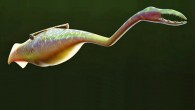
A team of paleontologists from the United States has determined that Tullimonstrum gregarium (popularly known as the Tully monster) — a large soft-bodied...

Mar 16, 2016 by News Staff

This illustration lays a depiction of the Sun’s magnetic fields over an image obtained by NASA’s Solar Dynamics Observatory (SDO) on March 12. SDO...

Mar 16, 2016 by News Staff

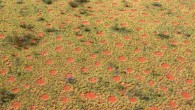
An international team of scientists, led by Dr. Stephan Getzin of the Helmholtz Center for Environmental Research in Germany, has announced the exciting...

Mar 16, 2016 by News Staff

New observations using the High Accuracy Radial velocity Planet Searcher (HARPS) spectrograph – a high-precision instrument on the 3.6-m telescope at...

Mar 15, 2016 by News Staff

Violent red flashes have been observed during the 2015 outburst of the nearby black-hole V404 Cygni. An artist’s impression of a black hole, similar...

Mar 15, 2016 by Enrico de Lazaro

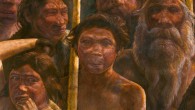
The first analysis of nuclear DNA from Sima de los Huesos hominins, conducted by Dr. Matthias Meyer of the Max Planck Institute for Evolutionary Anthropology...

Mar 15, 2016 by Enrico de Lazaro

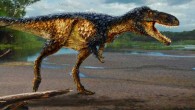
A new dinosaur cousin of T. rex – named Timurlengia euotica — has been found in the Kyzylkum Desert, northern Uzbekistan. A reconstruction of Timurlengia...

Mar 15, 2016 by News Staff

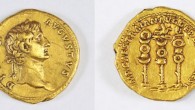
Laurie Rimon, from Kibbutz Kefar Blum in northern Israel, has found an extremely rare gold coin with the face of a Roman emperor. Obverse and reverse of...

Mar 15, 2016 by Enrico de Lazaro

Neanderthals lived mainly on mammoth and rhino meat, as well as some plant food, says a team of researchers led by Prof. Hervé Bocherens from the University...

Mar 14, 2016 by News Staff

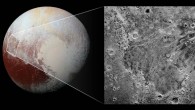
Members of the New Horizons mission team have discovered a huge ‘bite mark’ on the surface of the dwarf planet Pluto. ‘Bite mark’ on Pluto. The...

Mar 14, 2016 by News Staff

The ExoMars 2016 mission blasted off from Kazakhstan’s Baikonur Cosmodrome atop a Proton-M rocket at 02:31 a.m. PDT (05:31 a.m. EDT, 09:31 a.m. GMT,...

Mar 14, 2016 by Natali Anderson

NRAO’s Karl J. Jansky Very Large Array and two of NASA’s space telescopes — Chandra X-ray Observatory and Hubble — have captured a stunning...

Mar 12, 2016 by Enrico de Lazaro

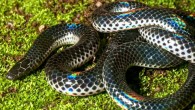
A new species of snake, named the Khaire’s black shieldtail (Melanophidium khairei), has been discovered in India. The Khaire’s black shieldtail (Melanophidium...

Mar 11, 2016 by News Staff

Tiny particles of stardust have been found in meteorites. Whether some of these particles, known as ‘pre-solar grains,’ came from classical novae is...

Mar 11, 2016 by Enrico de Lazaro

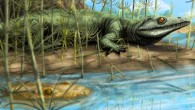
Fossil remains of a previously unknown species of reptile that lived about 250 million years ago (Triassic period) have been found in the Brazilian state...