News

Jun 20, 2014 by News Staff

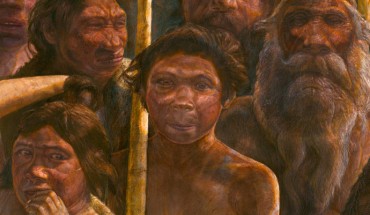
The Sima de los Huesos hominin, previously thought to belong to an ancient human species known as Homo heidelbergensis, is now reported to be an early member of the Neanderthal lineage. Sima de los Huesos hominins lived in what is now Spain about 400,000 years ago. Image credit: © Kennis & Kennis / Madrid Scientific Films. 500,000 to 400,000 years ago (Middle Pleistocene), archaic humans split off from other groups of that period living in Africa...

Jun 20, 2014 by News Staff

Astronomers have detected a clumpy gas stream flowing quickly outward and blocking 90 percent of the X-rays emitted by the supermassive black hole at the...

Jun 19, 2014 by News Staff

The exciting discovery of an extinct species of Tibetan fox adds more credence to the out-of-Tibet hypothesis, in which the Tibetan Plateau served as a...

Jun 19, 2014 by News Staff

Starbursts in dwarf galaxies played a bigger role than expected in the early Universe, according to new data from the Wide Field Camera 3 (WFC3), onboard...

Jun 19, 2014 by Enrico de Lazaro

Prof Olaf Kaper, an archaeologist at Leiden University in the Netherlands, believes he may have solved one of the greatest mysteries in ancient history...

Jun 19, 2014 by News Staff

A new research conducted by Prof Martin Nyffeler from the University of Basel and Prof Bradley Pusey from the University of Western Australia provides...

Jun 18, 2014 by News Staff

A team of paleontologists from Canada and the United States has discovered a new genus and species of horned, plant-eating dinosaur that lived during the...

Jun 18, 2014 by News Staff

A new mineral, believed to be the most abundant on our planet, has been named after U.S. physicist Percy Williams Bridgman (1882 – 1961), who won the...

Jun 18, 2014 by Natali Anderson

A new species of diminutive baleen whale that lived between 3.5 and 2.5 million years ago (Late Pliocene) has been described by U.S. paleontologists led...

Jun 17, 2014 by News Staff

A team of researchers from Canada has announced the discovery of the Earth’s highest latitude perennial spring, located in the polar desert of the Canadian...

Jun 17, 2014 by News Staff

Blue-enriched light exposure immediately before the evening meal may increase hunger, according to a new study published in the journal Sleep (abstract...

Jun 17, 2014 by News Staff

UK and Australian astronomers have developed a powerful new tool that could help detect chemical signs of alien life on planets outside of the Solar System. The...

Jun 17, 2014 by Natali Anderson

Protulophila, a microscopic marine animal thought to have been extinct for 4 million years, has been found living in seas around New Zealand. This scanning...

Jun 16, 2014 by News Staff

Geophysicists from the United States and Sweden have discovered ice blocks as tall as city skyscrapers at the very bottom of the Greenland Ice Sheet. The...

Jun 16, 2014 by News Staff

A group of entomologists headed by Dr Fernando Montealegre-Z from the University of Lincoln, UK, reported the discovery of a new genus and three species...

Jun 16, 2014 by News Staff

A new study reported in the journal Nature Climate Change questions fears that Europe and North America will experience more days of cold weather over...

Jun 16, 2014 by Sergio Prostak

A group of ornithologists led by Dr Trevor Price of the University of Chicago has described a new family of birds that is represented by just one species,...

Jun 15, 2014 by News Staff

The chemistry of the smoggy atmosphere of the Saturn’s largest moon, Titan, has been successfully simulated by NASA researchers in lab experiments. This...

Jun 14, 2014 by News Staff

Charon – the largest moon of the dwarf planet Pluto – may once have had a warm subterranean ocean, suggests a team of planetary scientists led...

Jun 13, 2014 by News Staff

A newly discovered fossil fish named Megamastax amblyodus is the largest vertebrate known in the Silurian fossil record, says a group of paleontologists...