News

Jul 8, 2014 by News Staff

Anthropologists are surprised by the presence of a unique inner-ear formation – long thought to occur only in Neanderthals – in an early human skull, dating back as far as 100,000 years and found at the Xujiayao site in Nihewan Basin, China. A reconstruction of Neanderthal man. Image credit: Neanderthal Museum. “The discovery places into question a whole suite of scenarios of later Pleistocene human population dispersals and interconnections...


Jul 8, 2014 by Enrico de Lazaro

Pelagornis sandersi – a newly discovered extinct species of bird that lived in what is now North America about 28 million years ago – is the largest...

Jul 7, 2014 by News Staff

Plants in the Central and South American genus Axinaea have a unique and highly complex bird pollination system, according to a new study published in...

Jul 7, 2014 by Sergio Prostak

The first ever systematic genetic analysis of evidence purporting to be from so-called anomalous primates such as yeti and migoi in the Himalaya, almasty...

Jul 7, 2014 by Sergio Prostak

 A new tracksite filled with hadrosaur footprints has been discovered in Denali National Park, Alaska, by a team of paleontologists led by Dr Yoshitsugu...

Jul 6, 2014 by News Staff

A detailed analysis of gravity and topography data from Titan, the largest moon of Saturn, provides strong evidence that the ocean inside the moon might...

Jul 5, 2014 by News Staff

Astronomers led by Dr Paul Robertson of the Pennsylvania State University say that signals that were suspected to be coming from two Earth-like exoplanets...

Jul 4, 2014 by News Staff

German paleontologists led by Dr Oliver Rauhut of the Ludwig-Maximilians-Universität in Munich, Germany, have discovered a new specimen of Archaeopteryx...

Jul 4, 2014 by News Staff

Using gravitational microlensing, a team of astronomers led by Prof Andrew Gould from Ohio State University has detected a cold terrestrial exoplanet orbiting...

Jul 3, 2014 by News Staff

Tibetans were able to adapt to high altitudes thanks to what is sometimes called the super-athlete gene, or more prosaically, EPAS1, they acquired when...

Jul 2, 2014 by News Staff

A team of astronomers using the Wide Field Imager on the MPG/ESO 2.2-m telescope at the La Silla Observatory, Chile, has captured a new image of a glowing...

Jul 2, 2014 by News Staff

A new study published in the journal Biology Letters shows that red kangaroos use their muscular tail just like a leg. The red kangaroo (Macropus rufus)...

Jul 2, 2014 by News Staff

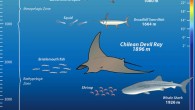
Previously thought to be ocean surface dwellers, box rays (Mobula tarapacana) can dive to depths of 2,000 meters, according to a team of scientists from...

Jul 1, 2014 by News Staff

A new study led by paleontologist John Scannella of Montana State University provides a detailed look at shifts in the morphology of Triceratops –...

Jul 1, 2014 by News Staff

A new study on the teeth of extinct sand tiger sharks Striatolamia macrota and Carcharias spp. has provided the first estimate of Eocene (50 million years...

Jul 1, 2014 by News Staff

According to a new study conducted by Washington State University anthropologists Dr Tim Kohler and Dr Kelsey Reese, pre-Columbian Native Americans experienced...

Jun 30, 2014 by News Staff

A team of astronomers using NASA’s three Sun-gazing spacecraft – Solar and Heliospheric Observatory (SOHO), Solar Terrestrial Relations Observatory...

Jun 30, 2014 by News Staff

After several weather delays, engineers from NASA’s Low-Density Supersonic Decelerator project have successfully tested a flying saucer-shaped spacecraft...

Jun 29, 2014 by News Staff

A team of astronomers led by Dr Robert Wittenmyer of the University of New South Wales has discovered a super-Earth orbiting near the inner edge of the...

Jun 28, 2014 by News Staff

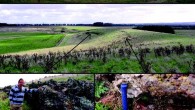
Scientists at Monash University have announced the discovery of three previously unrecorded ancient volcanoes in the Hamilton area of the Newer Volcanics...