News

Jan 12, 2017 by News Staff

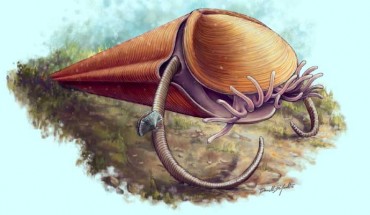
Paleontologists have finally determined what hyoliths — a group of extinct marine creatures — actually are. Reconstruction of the hyolith Haplophrentis on the Cambrian sea floor. Image credit: D. Dufault / Royal Ontario Museum. Hyoliths evolved over 530 million years ago during the Cambrian period and are among the first animals known to have produced mineralized external skeletons. Long believed to belong to the same family as snails,...
Jan 12, 2017 by News Staff

Milky Way’s 11 most distant stars are located roughly 300,000 light-years away from us. According to a team of astronomers at Harvard University, five...

Jan 12, 2017 by News Staff

In the Jan. 10 issue of the journal Stem Cell Reports, Dr. Michiko Mandai and colleagues at the RIKEN Center for Developmental Biology in Japan report...

Jan 11, 2017 by News Staff

A new species of ground beetle has been identified by Cornell University Professor James Liebherr. Holotype specimen of Bryanites graeffii. Image credit:...

Jan 11, 2017 by News Staff

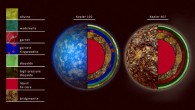
Astronomers and geoscientists from the United States and Brazil have joined forces to study the mix of major rock-building elements in exoplanet-hosting...

Jan 11, 2017 by News Staff

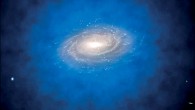
An international team of astronomers has discovered enormous halos of blue, faint light — made of so-called Lyman-alpha photons — around early...

Jan 11, 2017 by News Staff

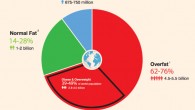
According to an international team of scientists from New Zealand and Australia, up to 76% of the world’s population is overfat. This amounts to an astonishing...

Jan 10, 2017 by News Staff

According to new research published in the journal Current Biology, a key area of the hummingbird brain processes motion in a unique, unexpected way. The...

Jan 10, 2017 by News Staff

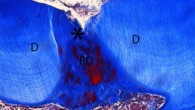
A novel method of stimulating the renewal of living stem cells in tooth pulp using an Alzheimer’s drug called Tideglusib has been discovered by scientists...

Jan 10, 2017 by News Staff

The European Southern Observatory (ESO) has signed an agreement with the Breakthrough Initiatives to adapt ESO’s Very Large Telescope instrumentation...

Jan 10, 2017 by News Staff

Retroviruses (Retroviridae) — a family of viruses that includes pathogens such as HIV, feline leukemia, and several cancer-causing viruses —...

Jan 9, 2017 by News Staff

An international team of biologists led by Washington State University Professor Haluk Beyenal has discovered a new type of cooperative photosynthesis...

Jan 9, 2017 by James Romero

Attempts to investigate the origin of giant wedge-shaped sedimentary structures on Saturn’s moon Titan using analogues in Death Valley, California has...

Jan 9, 2017 by News Staff

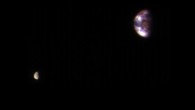
This image composite combines the best Earth image with the best Moon image from four sets of images acquired on November 20, 2016, by the High Resolution...

Jan 9, 2017 by News Staff

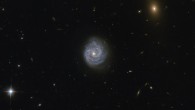
NASA has released a stunning image snapped by the NASA/ESA Hubble Space Telescope of the galaxy LEDA 1245565. This Hubble Advanced Camera for Surveys image...

Jan 8, 2017 by News Staff

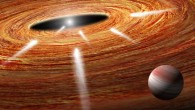
Exocomets are plunging into HD 172555, a nearby young star surrounded by a debris disk, according to a team of astronomers led by Carol Grady of NASA’s...

Jan 6, 2017 by News Staff

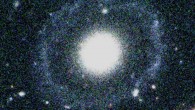
Astronomers have spotted for the first time an elliptical galaxy with two fairly round rings. PGC 1000714 (center). Image credit: Centre de Données astronomiques...

Jan 6, 2017 by News Staff

A new analysis of Chusang, an archeological site on the high-altitude Tibetan Plateau, suggests that permanent residents may have set up camp thousands...

Jan 6, 2017 by Enrico de Lazaro

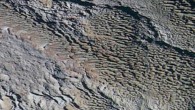
Planetary researchers using data from NASA’s New Horizons mission have found evidence of snow and ice features on the dwarf planet Pluto that, until...

Jan 6, 2017 by News Staff

A team of scientists at Michigan State University has discovered that a potential new drug, called CCG-203971, reduces the spread of melanoma cells by...