News

Jun 12, 2012 by Enrico de Lazaro

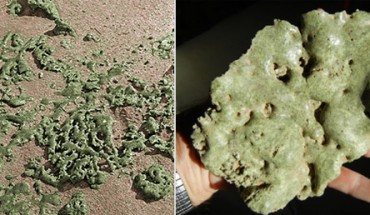
An international team of researchers has discovered melt-glass material in a thin layer of sedimentary rock in Pennsylvania, South Carolina, and Syria. The material – which dates back nearly 13,000 years – was formed at temperatures of 1,700 to 2,200 degrees Celsius, and is the result of a cosmic body impacting Earth. Images show melt glass known as trinitite formed at the ground surface from the melting of sediments and rocks by the very...
Jun 11, 2012 by News Staff

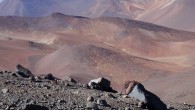
A new DNA analysis of rocky soils in the martian-like landscape on some volcanoes in South America has revealed a handful of bacteria, fungi, and other...

Jun 11, 2012 by News Staff

A new study by a team of biologists and geochemists from GEOMAR-Helmholtz Centre for Ocean Research Kiel, Germany, has demonstrated that Desulfobulbus...

Jun 8, 2012 by News Staff

Using NASA’s Wide-field Infrared Survey Explorer (WISE), an international team of scientists has discovered about 200 brown dwarfs, including a few...

Jun 8, 2012 by News Staff

Astronomers using NASA’s Spitzer Space Telescope have discovered what they believe is the faint, lumpy glow given off by the very first objects in...

Jun 8, 2012 by News Staff

Scientists at the University of California in Santa Cruz have found why insects got smaller despite rising oxygen levels about 150 million years ago. This...

Jun 8, 2012 by Natali Anderson

Researchers have discovered a massive bloom of phytoplankton beneath ice-covered Arctic waters. Until now, sea ice was thought to block sunlight and limit...

Jun 8, 2012 by News Staff

An international team of astrophysicists has discovered that black holes can change between two different modes, like changing the gears of an engine. Artist’s...

Jun 7, 2012 by Sergio Prostak

Fishery biologists led by Dr Roldan Muñoz of NOAA’s Beaufort Laboratory have for the first time observed headbutting contests between males of the world’s...

Jun 7, 2012 by Enrico de Lazaro

British scientists have developed a new technique to accurately measure the weight and size of dinosaurs and found they are not as heavy as previously...

Jun 7, 2012 by Enrico de Lazaro

Australian researchers have found that two common mango varieties contain natural compounds that may help fight obesity. Green mango A team from the University...

Jun 7, 2012 by Natali Anderson

A team of researchers at University of California in Berkeley has found that cockroaches can disappear in the blink of an eye by flinging themselves at...

Jun 6, 2012 by Sergio Prostak

Scientists have revealed new details on a 2,300-year-old beak-like weapon that an ancient warship used to ram enemy vessels in the First Punic War, the...

Jun 6, 2012 by James Freeman

Analyzing data from several telescopes, including NASA’s Chandra X-ray Observatory, an international team of astronomers has discovered a massive...

Jun 6, 2012 by News Staff

Israeli archaeologists have unearthed a spectacular 2000-year-old gold and silver hoard in the Qiryat Gat region. The 2000-year-old hoard from the Qiryat...

Jun 6, 2012 by News Staff

The reconstruction of human limb bones found in Atapuerca, Spain, has helped scientists to determine the height of the human species Homo heidelbergensis. The...

Jun 5, 2012 by Natali Anderson

Researchers at Georgia Institute of Technology have found how this blood-sucking insect can survive the high-speed impact of falling raindrops. Free-flying...

Jun 4, 2012 by Enrico de Lazaro

Tel Aviv University researchers have found that the ancient Egyptians developed unique system of volume measurement based on sphere units. A Phoenician...

Jun 1, 2012 by Natali Anderson

Scientists at Monash University in Australia have found how the zebrafish heals its spinal cord after injury. A zebrafish, Danio rerio, in an aquarium...

Jun 1, 2012 by News Staff

Using data from ESA’s XMM-Newton satellite, astronomers have detected a long-sought X-ray echo that promises a new way to probe supermassive black holes...