News

Jan 16, 2020 by News Staff

Shell fishing was a common activity of Neanderthals, according to new research led by University of Colorado, Boulder archaeologists. Homo neanderthalensis by Charles R. Knight. In 1949, archaeologists working at the site of Grotta dei Moscerini, a cave in the Latium region of central Italy, found a large collection of unusual artifacts: 171 shells of the smooth clam (Callista chione) that Neanderthals had picked up and shaped into sharp tools roughly...
Jan 16, 2020 by News Staff

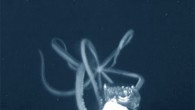
An international team of scientists has sequenced the genome of the giant squid (Architeuthis dux), the species which has inspired generations to tell...

Jan 16, 2020 by News Staff

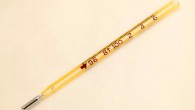
Scientists at the Stanford University School of Medicine have found that men born in the United States in the early 19th century had temperatures 0.59...

Jan 16, 2020 by Sergio Prostak

An international team of astronomers has detected a candidate super-Earth planet orbiting Proxima Centauri, the nearest star to the Sun. An artist’s...

Jan 15, 2020 by News Staff

Foods high in sucrose, or table sugar, influence brain reward circuitry in ways similar to those observed when addictive drugs are consumed, according...

Jan 15, 2020 by News Staff

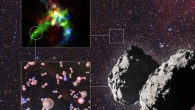
To understand how molecules containing phosphorus — one of life’s building blocks — are formed in star-forming regions, a team of astronomers...

Jan 15, 2020 by Enrico de Lazaro

Astronomers have detected five new planets, eight planet candidates, and confirmed three previously reported planets, around nine nearby M-dwarf (red dwarf)...

Jan 15, 2020 by News Staff

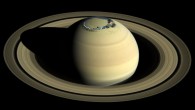
At the end of its mission in 2017, NASA’s Cassini spacecraft performed a set of ‘Grand Finale’ orbits bringing it closer to Saturn than ever before....

Jan 15, 2020 by Natali Anderson

An international team of researchers from the University of Oxford and the South Iceland Nature Research Centre has observed two Atlantic puffins (Fratercula...

Jan 14, 2020 by News Staff

In a series of experiments, a team of biologists at the University of California, San Diego studied the structure of growing colonies comprised of two...

Jan 14, 2020 by Enrico de Lazaro

Homo erectus, a hominin species that originated in equatorial Africa or the Caucasus region of Eurasia, arrived on the island of Java in Indonesia around...

Jan 14, 2020 by News Staff

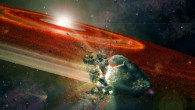
A new study, published in the journal Nature Astronomy, suggests that our young Solar System’s protoplanetary disk was divided into two regions: on the...

Jan 14, 2020 by Enrico de Lazaro

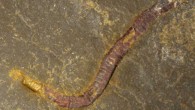
Paleontologists from the University of Missouri have discovered the well-preserved digestive tracts in the fossils of microscopic animals called cloudinomorphs....

Jan 14, 2020 by News Staff

Astronomers using the Atacama Large Millimeter/submillimeter Array (ALMA) have mapped the distribution of molecular gas in NGC 6240, a nearby merging galaxy...

Jan 13, 2020 by News Staff

A team of researchers from the United States, Switzerland and Australia has found 4.6 to 7-billion-year-old presolar grains of silicon carbide (SiC) in...

Jan 13, 2020 by Enrico de Lazaro

Astronomers using ESO’s Very Large Telescope have captured a striking view of two interacting galaxies NGC 470 and NGC 474. This image, taken by the...

Jan 13, 2020 by News Staff

In a study published in the Proceedings of the National Academy of Sciences, an international team of researchers examined the feelings evoked by 2,168...

Jan 13, 2020 by Enrico de Lazaro

The fossilized fruiting bodies of a myxomycete from the extant genus Stemonitis preserved in Kachin amber date back some 100 million years (mid-Cretaceous...

Jan 13, 2020 by Enrico de Lazaro

The NASA/ESA Hubble Space Telescope has taken a beautiful picture of a spiral galaxy called NGC 1803. This Hubble image shows NGC 1803, a spiral galaxy...

Jan 12, 2020 by Enrico de Lazaro

WASP-12b will be completely consumed by its host star in 3.25 million years, according to a new study led by Princeton University astrophysicists. An artist’s...