News

Jan 19, 2026 by News Staff

Dark matter may not have been ‘cold’ in the earliest moments after the Big Bang, as long believed; instead, new research from the University of Minnesota Twin Cities and the Universit’e Paris-Saclay suggests dark matter particles could have been incredibly hot, traveling near the speed of light in the primordial cosmos, before cooling down in time to seed the formation of galaxies and large-scale structure. Hypothetical dark matter particles....
Jan 19, 2026 by News Staff

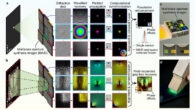
Inspired by a technique that allowed astronomers to image a black hole, scientists at the University of Connecticut developed a lens-free image sensor...

Jan 19, 2026 by News Staff

Stevens Institute of Technology physicist Igor Pikovski and colleagues are developing the first experiment designed to capture individual gravitons —...

Jan 16, 2026 by News Staff

Astronomers using the WHT Enhanced Area Velocity Explorer (WEAVE), a powerful new instrument mounted on the William Herschel Telescope on La Palma, have...

Jan 15, 2026 by News Staff

A comprehensive analysis of 17 fossil specimens reveals that Tyrannosaurus rex grew far more slowly than previously thought — reaching its full-grown...

Jan 15, 2026 by News Staff

Astrophysicists at the University of Copenhagen show that the enigmatic ‘little red dots’ — red sources scattered across images of the early...

Jan 15, 2026 by Enrico de Lazaro

A newly-described partial skeleton from the Koobi Fora Formation in northern Kenya is giving paleoanthropologists their most complete picture yet of Homo...

Jan 14, 2026 by Enrico de Lazaro

The woolly rhinoceros (Coelodonta antiquitatis) is a cold-adapted herbivore that went extinct around 14,000 years ago, but little is known about their...

Jan 14, 2026 by News Staff

SETI@home, the pioneering distributed-computing project launched in 1999 that enlisted millions of volunteers to analyze radio signals from space, produced...

Jan 13, 2026 by Enrico de Lazaro

At Leang Bulu Bettue, a rock-shelter in the Maros-Pangkep karst region on the Indonesian island of Sulawesi, paleoanthropologists have uncovered one of...

Jan 13, 2026 by Natali Anderson

A fish species called the armored rockhead poacher (Bothragonus swanii) carries a secret that has confounded marine biologists for decades: a deep, bowl-shaped...

Jan 13, 2026 by Enrico de Lazaro

Astronomers using NASA’s James Webb Space Telescope have captured the most detailed infrared view yet into the center of the Circinus Galaxy, one of...

Jan 13, 2026 by News Staff

In new experiments aboard the International Space Station (ISS), microbiologists from the University of Wisconsin-Madison and Rhodium Scientific Inc. have...

Jan 13, 2026 by News Staff

Using the high resolution images from the NIRCam (Near-InfraRed Camera) instrument onboard the NASA/ESA/CSA James Webb Space Telescope, astronomers have...

Jan 12, 2026 by Enrico de Lazaro

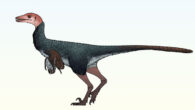
A team of paleontologists from Mexico and the United States has identified a new species of bird-like dinosaur with an unusually thick and domed skull,...

Jan 12, 2026 by News Staff

Physicists from the Center of Applied Space Technology and Microgravity at the University of Bremen and the Transylvanian University of Brașov have unveiled...

Jan 12, 2026 by News Staff

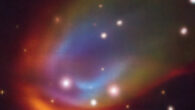
Using ESO’s Very Large Telescope (VLT), astronomers have captured a breathtaking shock wave around the white dwarf star 1RXS J052832.5+283824 (RXJ0528+2838...

Jan 12, 2026 by News Staff

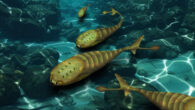
A long-standing mystery in vertebrate evolution — why most major fish lineages appear suddenly in the fossil record tens of millions of years after...

Jan 12, 2026 by News Staff

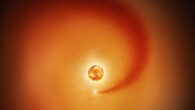
New multi-year observations from the NASA/ESA Hubble Space Telescope and ground-based telescopes at the Fred Lawrence Whipple Observatory and Roque de...

Jan 9, 2026 by News Staff

Astronomers have detected an extraordinary asteroid, named 2025 MN45, in early data from the Legacy Survey of Space and Time (LSST) Camera — the...