News

Nov 14, 2013 by News Staff

A team of archaeologists from the United States and Mexico has detected chili pepper residues in over 2,000-year-old pottery samples unearthed at the site of Chiapa de Corzo in southern Mexico. This image shows five vessels that tested positive for chili pepper. Each vessel had a culinary use. The second vessel from the right represents the earliest evidence of chili pepper consumption in Mexico, around 400 BC. Scale bar – 5 cm. Image credit: Roberto...

Nov 14, 2013 by Natali Anderson

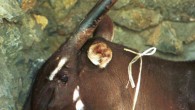
A well-preserved 6 to 4 million-year-old skull of a previously unknown species of prehistoric snow leopard from Tibet is the oldest big cat fossil ever...

Nov 13, 2013 by News Staff

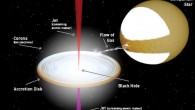
An international team of researchers using ESA’s XMM-Newton Space Telescope has found the first evidence of heavy atoms in jets emitted by a stellar-mass...

Nov 13, 2013 by News Staff

Scientists using the 2.2-m telescope at La Silla Observatory, Chile, have captured a stunning new image of glowing gas clouds around the young open star...

Nov 13, 2013 by News Staff

Camera traps set up in a remote corner of the Central Annamite mountains by World Wildlife Fund biologists have taken images of the saola (Pseudoryx nghetinhensis),...

Nov 13, 2013 by News Staff

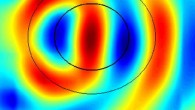
Two researchers at the University of Toronto have created and tested a new type of active invisibility cloak that can hide objects over a wide range of...

Nov 12, 2013 by News Staff

According to geologists led by Dr Antonio Simonetti from the University of Notre Dame, a detailed analysis of calcite-rich minerals from the 120-million-year-old...

Nov 12, 2013 by News Staff

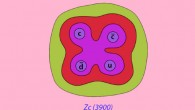
According to physicists of the Beijing-based BESIII experiment, their discovery of a new subatomic particle named Zc (4020) hints at a novel class of four-quark...

Nov 12, 2013 by News Staff

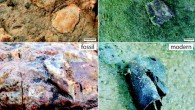
Dr Nora Noffke from Old Dominion University in Norfolk and her colleagues have unearthed evidence of complex microbial ecosystems in 3.48 billion year...

Nov 11, 2013 by News Staff

An international team of scientists led by Dr Patrick Hall of York University in Toronto has discovered a new type of quasars. This is an artist’s impression...

Nov 11, 2013 by Enrico de Lazaro

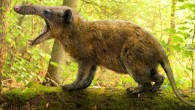
Paleontologists have described a new species of giant, spineless hedgehog that lived in what is today the Gargano peninsula of Italy during the late Miocene,...

Nov 8, 2013 by News Staff

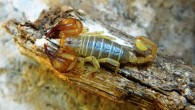
A team of entomologists has discovered a new scorpion species that lives in Muğla and Antalya provinces in southwestern Turkey. Euscorpius lycius, a male...

Nov 8, 2013 by News Staff

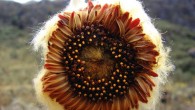
Biologists have announced the discovery of an extraordinary new species of flowering plant in the daisy family Asteraceae. Beautiful inflorescence of Coespeletia...

Nov 8, 2013 by News Staff

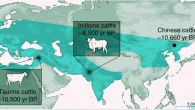
A new study reported in the journal Nature Communications provides the first multi-disciplinary evidence that humans in what is now China first domesticated...

Nov 8, 2013 by Natali Anderson

Ichthyologists have discovered a new species of scalloped hammerhead shark off the South Carolina coast. The Carolina hammerhead, Sphyrna gilberti. Image...

Nov 8, 2013 by News Staff

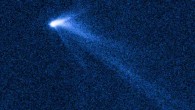
A group of scientists using NASA’s Hubble Space Telescope has discovered a unique multi-tailed object, labeled P/2013 P5, in the main asteroid belt. P/2013...

Nov 8, 2013 by News Staff

Wildlife Conservation Society biologists have discovered cave paintings made by hunter-gatherers between 10,000 to 4,000 years ago while studying wild...

Nov 7, 2013 by News Staff

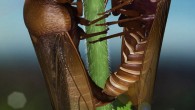
A team of scientists has found a well-preserved, 165-million-year-old fossil of copulating froghoppers, Anthoscytina perpetua, at the Daohugou village...

Nov 7, 2013 by News Staff

European scientists examined liquid basalt at record high pressures and temperatures to better understand how our planet evolved billions of years ago. Early...

Nov 7, 2013 by News Staff

An object that exploded over Chelyabinsk, Russia in February 2013 initially measured 20-m across and was about 4,452 million years old, according to three...