News

Dec 17, 2024 by News Staff

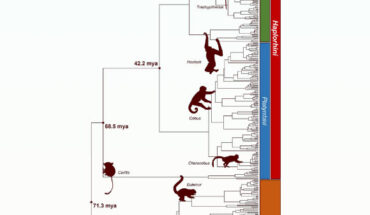
Primates, consisting of apes, monkeys, tarsiers, and lemurs, are among the most charismatic and well-studied animals on Earth. Phylogeny of 455 species of primates synthesized using Chrono-STA. The root of the phylogeny is recovered at 71.3 million years ago. The crown of Strepsirrhini is at 57 million years ago, and the crown of Haplorhini is at 68.5 million years ago. The crown of Simiiformes is at 42.2 million years ago. Image credit: Craig et...

Dec 17, 2024 by News Staff

One of these genetic variants was inherited from Neanderthals, according to a study led by University College London researchers. El Sidron Neanderthals...

Dec 17, 2024 by Enrico de Lazaro

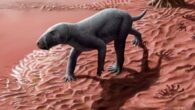
Paleontologists have discovered a new species of early gorgonopsian therapsid that was part of an ancient summer wet biome of equatorial Pangea. Life reconstruction...

Dec 17, 2024 by News Staff

Saturn’s icy rings could be much older than they appear due to their resistance to pollution from impacts with rocky debris. Hyodo et al. suggest that...

Dec 16, 2024 by Enrico de Lazaro

Paleontologists have identified a new species of procolophonid reptile from the fossilized skull and jaw fragments found in southwest England. Life reconstruction...

Dec 16, 2024 by News Staff

In 2003, Hubble provided evidence of a massive exoplanet around a very old star. Such stars possess only small amounts of heavier elements that are the...

Dec 16, 2024 by News Staff

A radiation-resistant bacterium called Deinococcus radiodurans can withstand radiation doses thousands of times higher than what would kill a human. The...

Dec 16, 2024 by News Staff

Physicists with the ALICE Collaboration at CERN’s Large Hadron Collider (LHC) have seen the first ever evidence of antihyperhelium-4, which is composed...

Dec 16, 2024 by Enrico de Lazaro

Astronomers using the NASA/ESA Hubble Space Telescope have captured a striking new photo of the barred spiral galaxy NGC 2566. A prominent bar of stars...

Dec 13, 2024 by News Staff

In a genomic study encompassing more than 300 genomes, researchers determined the time period during which Neanderthals interbred with modern humans, starting...

Dec 13, 2024 by News Staff

Volcanic activity on Io — the innermost Galilean moon of Jupiter and the most volcanically active body in the Solar System — is unlikely to...

Dec 12, 2024 by News Staff

Scientists have sequenced and analyzed the genomes of seven individuals who lived between 42,000 and 49,000 years ago in Ranis, Germany and Zlatý kůň,...

Dec 12, 2024 by News Staff

Altermagnetism is a distinct form of magnetic order where the tiny constituent magnetic building blocks align antiparallel to their neighbors, but the...

Dec 12, 2024 by News Staff

Nicknamed the Firefly Sparkle, the newly-discovered galaxy existed approximately 600 million years after the Big Bang and consisted of a least 10 star...

Dec 11, 2024 by News Staff

In a new study published in the journal PLoS ONE, archaeologists examined the exceptional human remains from the Middle Trypillia site of Kosenivka (ca....

Dec 11, 2024 by News Staff

New observations from the NASA/ESA/CSA James Webb Space Telescope confirms previous measurements by the NASA/ESA Hubble Space Telescope of distances between...

Dec 11, 2024 by News Staff

New research led by University of Bristol scientists sheds light on how lepidosaurs — the most diverse clade of tetrapods, including lizards and...

Dec 11, 2024 by Natali Anderson

Palaeospondylus gunni, a small creature with an eel-like body that lived during the Middle Devonian epoch around 390 million years ago, is represented...

Dec 11, 2024 by News Staff

Messier 77 is a well-known, relatively nearby, bright spiral galaxy with a supermassive black hole at its center. An artist’s concept of Messier 77,...

Dec 10, 2024 by Enrico de Lazaro

The Shangshan culture in ancient China’s Lower Yangzi region is central to understanding the origins of rice domestication and early alcohol fermentation....