News

Jun 24, 2025 by News Staff

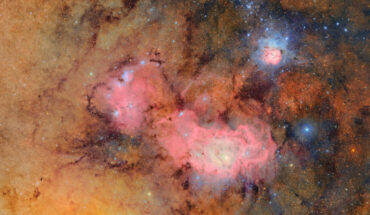
The Vera C. Rubin Observatory is a major new scientific facility jointly funded by NSF and the U.S. DoE’s Office of Science. The new images are a small preview of the observatory’s upcoming 10-year scientific mission to explore and understand some of the Universe’s biggest mysteries. This composite combines 678 separate images, taken by NSF-DOE Vera C. Rubin Observatory in just over seven hours of observing time, and shows the Trifid (top right)...
Jun 24, 2025 by Natali Anderson

New research led by scientists from the Ruhr-University Bochum, the University of Prince Edward Island, Ankara University and the University of Bari Aldo...

Jun 23, 2025 by News Staff

Discovery of human footprints at White Sands, New Mexico, dated to between 21,000 and 23,000 years ago, was a notable step in understanding the initial...

Jun 23, 2025 by News Staff

A new theory by University of Alaska Fairbanks scientist Gunther Kletetschka argues that time comes in three dimensions rather than just the single one...

Jun 23, 2025 by News Staff

Honey from Australian stingless bees, commonly referred to as sugarbag bees, has historically served as a food source. It is also a traditional remedy...

Jun 23, 2025 by News Staff

A team of physicists from Germany, Finland, India and Japan has discovered a new isotope of the synthetic chemical element seaborgium. Mosat et al. report...

Jun 23, 2025 by Enrico de Lazaro

The NASA/ESA Hubble Space Telescope shot this image of UGC 11397, a barred spiral galaxy that is hosting an actively growing supermassive black hole. This...

Jun 20, 2025 by Enrico de Lazaro

The discovery of Litoria tylerantiqua suggests that Australian treefrogs (pelodryadids) were present in Australia by the Early Eocene, when the continent...

Jun 20, 2025 by News Staff

The first generation of stars (Population III) must have formed from the unenriched gas that permeated the infant Universe. These stars produced the first...

Jun 19, 2025 by News Staff

During periods known as Snowball Earth, between 720 and 635 million years ago, early eukaryotes — complex cellular lifeforms that eventually evolved...

Jun 19, 2025 by News Staff

Each spring, billions of Bogong moths (Agrotis infusa) escape hot conditions across southeast Australia by migrating up to 1,000 km to a place that they...

Jun 19, 2025 by Enrico de Lazaro

The famous ‘Harbin cranium’ dates back to at least 146,000 years ago and was previously assigned to a new species, Homo longi. A reconstruction of...

Jun 18, 2025 by News Staff

Pre-contact Central and South American dogs (Canis familiaris) — all dogs preceding contact with European settlers — descended from a single...

Jun 18, 2025 by News Staff

Astronomers using the Multi Unit Spectroscopic Explorer (MUSE) instrument on ESO’s Very Large Telescope (VLT) have observed the active starburst (star-forming)...

Jun 18, 2025 by Enrico de Lazaro

New fossilized specimens of monstersaurs — including a previously unknown genus and species, Bolg amondol — from the Kaiparowits Formation...

Jun 18, 2025 by News Staff

Silicon has enabled advancements in semiconductor technology through miniaturization, but scaling challenges necessitate the exploration of new materials....

Jun 18, 2025 by News Staff

In new research, paleontologists combined data on the distribution of Triassic pterosauromorph (pterosaur + lagerpetid) fossils with information on the...

Jun 17, 2025 by News Staff

In a new paper published in the Monthly Notices of the Royal Astronomical Society, astronomers from the University of Leicester describe for the first...

Jun 17, 2025 by Enrico de Lazaro

A ream of paleontologists at the University of Zurich reports a chronic case of osteomyelitis (bone tissue infection) in Plateosaurus trossingensis, one...

Jun 17, 2025 by News Staff

Astronomers using the Atacama Large Millimeter/submillimeter Array (ALMA) have observed comet C/2014 UN271 (Bernardinelli-Bernstein) — the largest...