News

Oct 27, 2025 by Sergio Prostak

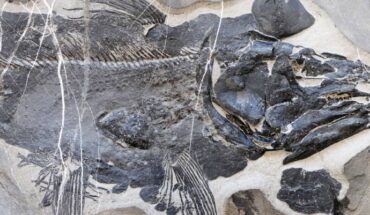
Paleontologists in China have described a new species of the coelacanth genus Whiteia on the basis of two fossilized specimens. This discovery extends the spatial range of Whiteia in the Early Triassic, and documents the oldest species of the genus in Asia, predating the previously oldest record of whiteiid coelacanths in this continent by 9 million years. Whiteia anniae in right lateral view, holotype. Image credit: Dai et al., doi: 10.1038/s41598-025-20229-w. “Coelacanths...


Oct 27, 2025 by Natali Anderson

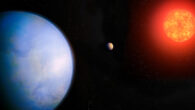
The binary stellar system TOI-2267 likely harbors two warm Earth-sized exoplanets and an additional Earth-sized candidate, according to a new paper published...

Oct 27, 2025 by Enrico de Lazaro

Paleontologists have discovered two partial skulls and three partial jaws from an early-diverging dyrosaurid crocodyliform in the layers of the Quseir...

Oct 27, 2025 by Enrico de Lazaro

This image taken with the NASA/ESA Hubble Space Telescope provides a detailed new look at the star-studded spiral galaxy NGC 4571. This Hubble image shows...

Oct 27, 2025 by News Staff

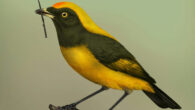
Paleontologists have found the 2.9-cm-long fossilized foot bone of a possible bowerbird species at the Miocene locality of St Bathans in Aotearoa New Zealand. Life...

Oct 24, 2025 by Enrico de Lazaro

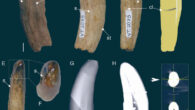
Paleontologists have uncovered the fossilized lower right canine of a large proborhyaenid sparassodont in the Taubaté Basin of Brazil. The right lower...

Oct 23, 2025 by News Staff

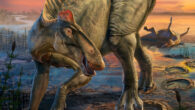
Paleontologists have examined two exceptional specimens of the end-Cretaceous, duck-billed dinosaur Edmontosaurus annectens. Using an array of imaging...

Oct 23, 2025 by News Staff

The most iconic mass extinction in Earth history occurred around 66 million years ago, as rapid environmental destruction led to the extinction of around...

Oct 23, 2025 by Natali Anderson

Gliese 251 is an early red dwarf star and the 74th closest star system to our Sun. An artist’s conception of the Gliese 251 system, showing Gliese 251c...

Oct 22, 2025 by News Staff

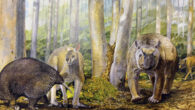
In a new study, University of New South Wales Professor Mike Archer and colleagues re-examined the fossilized tibia (lower leg bone) of a now-extinct,...

Oct 22, 2025 by News Staff

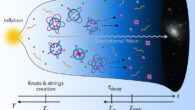
Knots emerge in various fields of mathematics and physics today. A team of physicists from Japan and Germany suggests that, during the early Universe,...

Oct 22, 2025 by News Staff

Both avian and non-avian reptiles excrete excess nitrogen in solid form — colloquially termed ‘urates’ — as an evolutionary adaptation...

Oct 21, 2025 by News Staff

This streamer of gas is channeling matter from the surrounding cloud of a star-forming region in Perseus directly onto a newborn binary star system called...

Oct 21, 2025 by News Staff

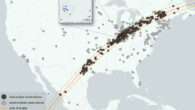
On April 8, 2024, a total solar eclipse disrupted light-dark cycles for North American birds during the lead-up to spring reproduction. Compiling more...

Oct 21, 2025 by News Staff

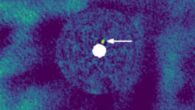
Using a combination of the Subaru Telescope, the W. M. Keck Observatory, ESA’s Gaia mission, astronomers have imaged a brown-dwarf companion around the...

Oct 21, 2025 by Natali Anderson

Titan offers great motivation for the detailed study of organic chemistry in unconventional conditions. Nonpolar hydrocarbons such as ethane and methane...

Oct 21, 2025 by News Staff

Paleoanthropologists have unearthed and examined a hominin partial skeleton that includes hand and foot bones unambiguously associated with skull elements...

Oct 20, 2025 by Enrico de Lazaro

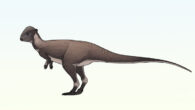
Paleontologists have described a new genus and species of pachycephalosaurid dinosaur from five fossil specimens found in the Late Cretaceous Two Medicine...

Oct 20, 2025 by News Staff

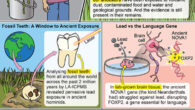
Several hominids — Australopithecus africanus, Paranthropus robustus, early Homo sp., Gigantopithecus blacki, Pongo sp., Papio sp., Homo neanderthalensis,...

Oct 20, 2025 by News Staff

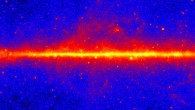
The Galactic Center excess is an unexpected concentration of gamma-rays emerging from the center of our Milky Way Galaxy. This view shows the entire sky...