News

Feb 2, 2023 by Enrico de Lazaro

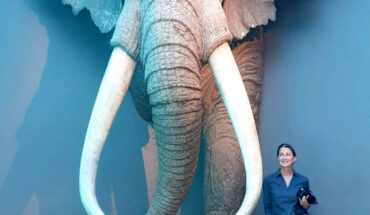
Straight-tusked elephants (Palaeoloxodon antiquus) were the largest terrestrial mammals of the Pleistocene epoch, present in Europe and western Asia between 800,000 and 100,000 years ago. A new analysis of 125,000-year-old bones of straight-tusked elephants from ancient lake deposits in Germany shows that hunting of these enormous animals was part of the cultural repertoire of Neanderthals there, over 2,000 years, many dozens of generations. Professor...

Feb 2, 2023 by Enrico de Lazaro

Paleontologists have examined the fossilized brain and cranial nerve soft tissues of Coccocephalus wildi, a species of early ray-finned fish that lived...

Feb 1, 2023 by News Staff

A team of researchers at the University of Toronto has developed a multilayered fluidic system that can reduce the energy costs of heating, cooling and...

Feb 1, 2023 by News Staff

The principal animal lineages diverged in the Cambrian period, but most diversity at lower taxonomic ranks arose more gradually over the subsequent 500...

Feb 1, 2023 by Natali Anderson

About 50 species of birds on Earth today do not belong to the same group as the other 10,000 currently in existence. Known as the paleognaths, this small...

Feb 1, 2023 by News Staff

Using NASA’s Chandra X-ray Observatory, ESA’s XMM-Newton and three radio telescopes (the Giant Metrewave Radio Telescope, the Low Frequency Array,...

Jan 31, 2023 by Enrico de Lazaro

LEDA 2046648 is accompanied by a profusion of smaller, more distant galaxies which range from fully-fledged spirals to mere bright smudges. This Webb image...

Jan 31, 2023 by News Staff

Mimas, a small moon of Saturn, is heavily cratered and lacks the typical characteristics of an ocean-bearing moon, such as the active surface of Enceladus....

Jan 31, 2023 by News Staff

In a new paper published in the journal Nature Astronomy, astronomers with Breakthrough Listen Initiative — the largest ever scientific research...

Jan 31, 2023 by Enrico de Lazaro

Turnersuchus hingleyae, a new genus and species of thalattosuchian crocodylomorph from the Early Jurassic epoch, helps fill a gap in the fossil record...

Jan 31, 2023 by News Staff

The Night Watch, painted in 1642 and on view in the Rijksmuseum in Amsterdam, is considered Rembrandt’s most famous work. In new research, scientists...

Jan 30, 2023 by Sergio Prostak

Hibbertopterus lamsdelli is only the fourth, yet most reliable record of an American hibbertopterid sea scorpion. Life reconstruction of a hibbertopterid...

Jan 30, 2023 by News Staff

A combination of proteins and antioxidants doubles the anti-inflammatory properties in immune cells, according to a new paper published in the Journal...

Jan 30, 2023 by News Staff

Astronomers using the NASA/ESA/CSA James Webb Space Telescope have captured the reflectance spectrum of the double-ringed centaur 10199 Chariklo and observed...

Jan 30, 2023 by News Staff

The robot’s design is inspired by the seed of dandelion, resembling several biomimetic features, i.e., high porosity, lightweight, and separated vortex...

Jan 30, 2023 by Enrico de Lazaro

Astronomers using the NASA/ESA Hubble Space Telescope have captured a spectacular image of a very turbulent part of the Tarantula Nebula. This new Hubble...

Jan 27, 2023 by News Staff

Magnetars are a special subset of the isolated neutron star family, with X-ray and radio emission mainly powered by the decay of their immense magnetic...

Jan 27, 2023 by News Staff

Paleontologists have described two new species of the early primatomorphan genus Ignacius from Ellesmere Island, Nunavut, Canada. Life reconstruction of...

Jan 27, 2023 by News Staff

A small near-Earth asteroid designated 2023 BU made its closest approach on January 26, 2023 at 7:29 p.m. EST (4:29 p.m. PST, or January 27, 2023 at 00:29...

Jan 26, 2023 by News Staff

Spider binary systems contain a pulsar — the superdense, rapidly rotating remains of a star that exploded as a supernova — that slowly erodes...