News

Aug 9, 2023 by Enrico de Lazaro

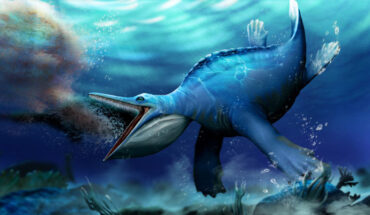
Hupehsuchus nanchangensis, a species of marine reptile that lived between 249 and 247 million years ago in what is now China, had soft structures such as an expanding throat region to allow it to engulf great masses of water containing shrimp-like prey, and baleen whale-like structures to filter food items as it swam forward. Reconstruction of Hupehsuchus nanchangensis about to engulf a shoal of shrimps. Image credit: Shunyi Shu & Long Cheng,...

Aug 9, 2023 by News Staff

To track the Red Planet’s spin rate, planetary scientists relied on the Rotation and Interior Structure Experiment (RISE) onboard NASA’s InSight lander....

Aug 9, 2023 by Enrico de Lazaro

Chaetae are stiff bristles made of chitin that characterize many species of annelid worms. Reconstruction of Shaihuludia shurikeni from the Spence Shale...

Aug 8, 2023 by Enrico de Lazaro

The newly-discovered Roman road network system privileged the movement of animal-drawn wheel vehicles and is possibly the result of an evolutionary model,...

Aug 8, 2023 by Enrico de Lazaro

Obesity is a major risk factor for various chronic diseases, especially lifestyle-related diseases. Therefore, finding a protective substance against obesity...

Aug 7, 2023 by Natali Anderson

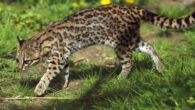
The only known specimen of the small spotted cat species Leopardus narinensis was found on the Galeras Volcano in southern Colombia in 1989. The tigrina...

Aug 7, 2023 by Enrico de Lazaro

New research by paleontologists from the University of California, Riverside and the Universidad Complutense de Madrid focuses on Aulacopleura koninckii,...

Aug 7, 2023 by News Staff

New results from the High Altitude Water Cherenkov (HAWC) observatory extend the bright, hard gamma-ray emission from the solar disk observed with NASA’s...

Aug 7, 2023 by News Staff

Obesity and its associated metabolic diseases have had devastating health consequences on modern society. New research from the University of Colorado...

Aug 7, 2023 by Enrico de Lazaro

Astronomers using the NASA/ESA Hubble Space Telescope have captured an amazing new photo of the lenticular galaxy NGC 6684. This Hubble image shows NGC...

Aug 4, 2023 by Enrico de Lazaro

Fossil plant phytoliths from the digestive tract of Jeholornis prima — an extinct species of bird that lived in what is now China during the Early...

Aug 4, 2023 by Enrico de Lazaro

Using data from TRAPPIST-South/North, SPECULOOS, and MuSCAT3 facilities, astronomers have discovered an unusual Jupiter-sized exoplanet orbiting the red...

Aug 3, 2023 by News Staff

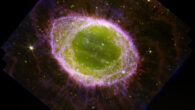
New images from the NASA/ESA/CSA James Webb Space Telescope show the intricate and ethereal beauty of the famous Ring Nebula, also known as Messier 57,...

Aug 3, 2023 by News Staff

The global extent of supplementary bird feeding is unknown but has consequences for bird conservation and human well-being. Using a measure of search intensity...

Aug 3, 2023 by Enrico de Lazaro

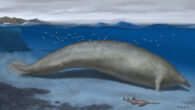
Perucetus colossus substantially pushes the upper limit of skeletal mass in mammals, as well as in aquatic vertebrates in general. This early basilosaurid...

Aug 2, 2023 by Natali Anderson

Einkorn (Triticum monococcum) was the first domesticated wheat species, and was central to the birth of agriculture and the Neolithic Revolution in the...

Aug 2, 2023 by News Staff

Plant-eating insects are the most diverse group of multicellular organisms on Earth. The most discussed drivers of their inordinate taxonomic and functional...

Aug 2, 2023 by News Staff

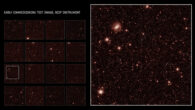
Euclid, built and operated by ESA, with contributions from NASA, will observe billions of galaxies out to 10 billion light-years to create the largest,...

Aug 2, 2023 by News Staff

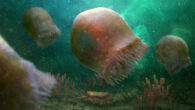
Burgessomedusa phasmiformis had a cuboidal umbrella up to 20 cm (8 inches) high and over 90 short, finger-like tentacles. Artistic reconstruction of a...

Aug 2, 2023 by Enrico de Lazaro

Researchers from Texas A&M University and elsewhere have assessed the biochemical, histological and molecular effects of whole pecans (Carya illinoinensis)...