


Archaeology

5,300-Year-Old Drilling Tool Found in Egypt

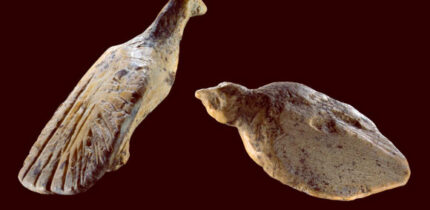
Original photograph of the Badari drill published in 1927 by Guy Brunton (left) and the actual artifact. Image credit: Martin Odler & Jiří Kmošek, doi: 10.1553/AEundL35s289.

A tiny copper-alloy object long dismissed as a simple awl has been reclassified as the earliest known rotary metal drill from ancient Egypt. Original photograph of the Badari drill published in 1927 by Guy Brunton (left) and the actual artifact. Image credit: Martin Odler & Jiří Kmošek, doi: 10.1553/AEundL35s289. The ancient drill is only 6.3 cm (2.5 inches) long and weighs about 1.5 grams. Dating...

Biology

Bonobos Demonstrate Imaginative Ability in New Experiments

Kanzi the bonobo. Image credit: Ape Initiative.

The consistent performance of Kanzi the bonobo in pretend play experiments suggests that the mental capacity to imagine nonexistent objects may trace back 6 to 9 million years, rewriting assumptions about the uniqueness of human imagination. Kanzi the bonobo. Image credit: Ape Initiative. “It really is game-changing that their mental lives go beyond the here and now,” said Dr. Christopher Krupenye,...

Physics

Ultra-High-Energy Neutrino May Signal First Glimpse of Primordial Black Hole Explosion

The KM3NeT experiment has recently observed a neutrino with an energy around 100 PeV, and IceCube has detected five neutrinos with energies above 1 PeV; while there are no known astrophysical sources, exploding primordial black holes could have produced these high-energy neutrinos. Image credit: Gemini AI.

Physicists at the University of Massachusetts Amherst argue that an ultra-high-energy neutrino detected by the KM3NeT experiment could be the signature of an explosion of a ‘quasi-extremal primordial black hole,’ pointing toward new physics beyond the Standard Model. The KM3NeT experiment has recently observed a neutrino with an energy around 100 PeV, and IceCube has detected five neutrinos with...

Geology

New Research Uncovers Hidden Complexity beneath Martian Surface

This perspective view from ESA’s Mars Express shows three of Mars’ famously colossal volcanoes (from left to right): Arsia, Pavonis and Ascraeus Mons. Image credit: ESA / DLR / FU Berlin.

New orbital data reveal that the most recently active volcanic systems on Mars weren’t simple one-off blasts into space; instead, long-lived magmatic plumbing beneath Pavonis Mons, one of the Red Planet’s largest volcanoes, reshaped lava flows over time, with distinct eruptive phases and evolving chemical signatures, offering fresh insights into the planet’s inner dynamics and how rocky planets...